Film and installation · Margate, UK · 2017
The Ships Are Always There
The Ships Are Always There is a looped video work about the constants in one's life. Although the ships are the visible subject, the sound includes my daughter Delphine and our dog T-Bone. Their presence makes the work as much about the familiar rhythms of personal life as about what can be seen on the horizon.

Related project idea and research · September 2017 · Margate
The Ships Will Always Return
The Ships Will Always Return developed from The Ships Are Always There into a proposal for a narrative installation of multiple projected images, film fragments and sound. Unlike the film above, this was a research idea, not a documented completed installation.
The proposal envisaged collecting found objects, photographs, recordings and other traces of human activity, then developing stories from their known histories and the gaps in what could be established. Rather than presenting a single linear film, separate projections and sound sources would surround visitors, inviting them to move through intersecting fragments.
At its centre was a question about memory: how much of a story comes from evidence, and how much is supplied by imagination? A photograph or an object can suggest a life without revealing it. Research might clarify part of its history, while other parts remain unknowable.
The idea extended concerns present elsewhere in my work, particularly storytelling, personal history, the archive and the relationship between material traces and interpretation. The related slideshow Forgotten People was referenced in the original proposal as a smaller-scale exploration of found images and the stories made from them.
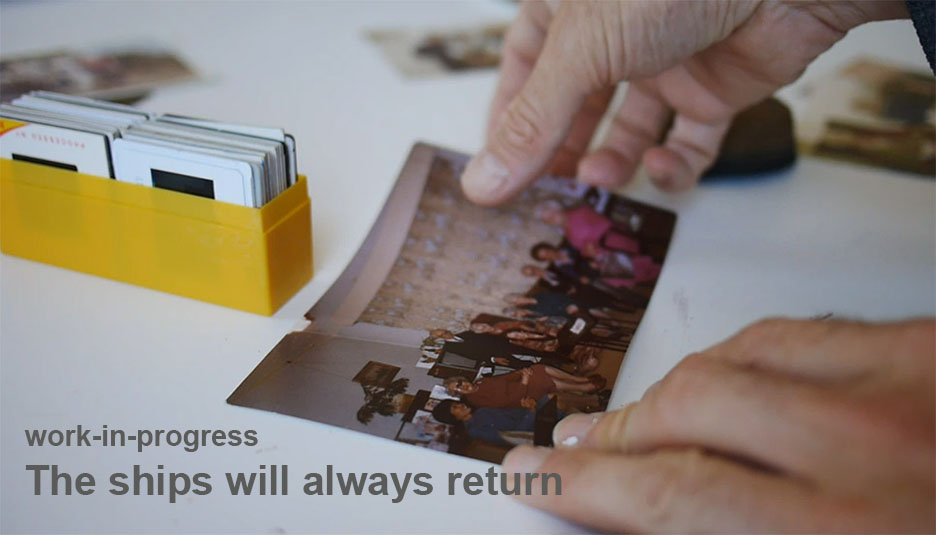
From the research notes, 2017
When there is a story to be told and you cannot see the story, what do you do? Do you invent the story?
Through the lens of my camera, I scan across the white IKEA tabletop. Photographs I bought at a second-hand store around the corner. It took me hours to select the few pictures I have. They are all very special for one reason or another.
I am looking at each photograph, studying them one by one, hours on end. But nothing. Nothing emerges from beyond. I cannot see any connections, I cannot see anything. As if I am blind or the photographs are black holes.
Walking across the vast beach, sand underneath my feet. I found many small treasures on this beach. Some of the items might have travelled around the world to these shores. Centuries of thought and workmanship in each of these things.
Research notes lightly edited for spelling and readability.